by
by Is AI fundamentally changing human behavior in ways that might surprise you? Wondering how your marketing should change?
In this article, you'll discover how AI is transforming human behavior and learn how to prepare your content marketing for a rapidly changing reality.
Why Understanding AI's Impact on Human Behavior Matters for Marketers
The rise of AI represents more than just another technological advancement—it's fundamentally rewiring how people think, make decisions, and interact with the world around them. For marketers and business professionals who need to understand their customers better than anyone else, grasping these behavioral shifts has become essential for survival and success.
The opportunity for marketers who understand these changes early is substantial. Just as those who recognized the shift toward video content and shorter formats five or six years ago were able to ride that wave successfully, those who grasp how AI is changing customer behavior today will have a significant competitive advantage tomorrow.
Mark Schaefer's insights about AI's impact on human behavior aren't just his personal observations—they're built on substantial research. Earlier in the year, Elon University brought together three hundred futurists, technologists, psychologists, philosophers, and academics to answer one question: How will AI change humanity by 2035? The resulting report was so compelling that Schaefer asked for and received permission to turn this research into his latest book, How AI Changes Your Customers.
“We don't really know where AI is going to head. Even the people, the insiders in Silicon Valley, really don't know. But I think when these futurists reach consensus on some big ideas, we'd better pay attention,” Schaefer explains.
AI Is Becoming the New Decision Maker
One of the most significant behavioral shifts Schaefer identifies is the increasing trust people place in AI for major life decisions. He uses the analogy of marketing diapers: when marketing diapers, you're not marketing to the baby who uses them but to the parents who make the purchasing decision. Similarly, with AI increasingly becoming the decision-maker, marketers may need to market to the AI rather than directly to the end user.
This shift has profound implications for marketing strategy. Unlike Google, which provides a list of suggestions or links for users to explore, AI often provides definitive recommendations. When ChatGPT announced it was embedding e-commerce directly into its answers, starting with partnerships with Shopify and eBay, it signaled a future where AI doesn't just influence decisions but facilitates transactions directly.
The challenge for businesses becomes clear: How do you ensure your brand appears in AI recommendations when competing against potentially hundreds of thousands of other options? Schaefer suggests that rather than trying to optimize for AI recommendations alone, businesses should focus on building strong brand preferences that can serve as overrides to AI suggestions.
Case Study: How People Are Making Decisions with AI
To illustrate how profoundly AI is changing decision-making, Schaefer shares a detailed story about planning a five-day trip to Paris. Before giving a speech in Europe, he decided to spend time in Paris and turned to ChatGPT for planning. He told the AI he loves art, history, music, and nature, then asked it to plan a five-day trip, including where to go, what times to visit, restaurants along the way, metro stops, and all logistical details.
The AI created a comprehensive itinerary that Schaefer followed one hundred percent—and it was, in his words, “absolutely stunningly perfect.”

The AI's recommendations were remarkably sophisticated, down to details like how much time it would take to walk from a museum to the train station, which hours to visit specific locations, and even insider tips. For instance, it advised him not to use the main entrance at the Louvre but instead to use another entrance by the subway station for much faster access—advice that proved accurate.
This experience demonstrates how AI has become sophisticated enough that people trust it completely for complex decision-making. Schaefer didn't second-guess or verify the recommendations; he simply followed them and had an excellent experience. This represents a fundamental shift in how humans approach planning and decision-making.
However, Schaefer's Paris story reveals something even more important for marketers: the concept of brand override. While he followed the AI's recommendations for everything else, there were two crucial exceptions. First, when it came to choosing an airline, he specifically told the AI he wanted to fly Delta Airlines. Despite the AI potentially having access to cheaper or more convenient options, his brand preference overrode any algorithmic recommendation.
Ready to Supercharge Your Marketing Strategy?

Get expert training and an unbeatable conference experience when you attend Social Media Marketing World—from your friends at Social Media Examiner.
Broaden your reach, skyrocket your engagement, and grow your sales. Become the marketing hero your company or clients need!
🔥 Save $800 on an All-Access ticket. Sale Ends Tuesday! 🔥
GET THE DETAILSThese types of overrides reveal a crucial insight for marketers: no matter how sophisticated AI becomes, strong brand preferences and emotional connections can override algorithmic recommendations. As Schaefer explains, “Brand preference is an override. No matter what AI says, I am going to follow the brands that I love.”
How to Prepare Your Business for AI-Driven Behavior Changes
For marketers and business owners ready to prepare for AI-driven behavior changes, Schaefer offers several concrete steps:
#1: Let AI Access Your Content
One of Schaefer's most controversial recommendations is to invite AI to crawl and index your content. He reveals that many website security services like Cloudflare have a default setting that keeps AI out. Upon learning this, Schaefer immediately instructed his web team to toggle off this protection.
“I want AI all over my site,” he declares. He acknowledges the emotional response many creators have to AI consuming their content without permission or payment—all of his books are in AI systems without his consent, attribution, or compensation. However, he argues for taking the long view: “The economic value of content that's not seen and shared is zero.”
This perspective requires creators to overcome their emotional reactions and think strategically. Schaefer argues that just as previous generations of marketers had to accept that search engines would crawl and index their content, today's marketers must accept that AI will do the same. The choice isn't whether AI will have access to your content, but whether you'll make it easy for AI to understand and recommend your business.
#2: Use a Two-Audience Strategy for Content Creation
One of Schaefer's most provocative suggestions is that businesses may need to develop separate content strategies for human and AI audiences. He's adamant about not compromising his human audience—his blog readers, podcast listeners, and book readers. His content for humans will always be worth their time, make them think, and provide value through engaging, interesting, and sometimes entertaining delivery.
AI Is No Longer Optional for Marketers—Ready to Master It?

Join over a thousand forward-thinking marketers at AI Business World—a conference-in-a-conference at Social Media Marketing World.
Get two days of practical AI training where you'll discover:
✅ Systems that 3x your output—leaving time for strategy and creativity
✅ Proven strategies you can deploy right away—no guesswork, no wasted budget
Become the indispensable AI expert your company needs.
GET YOUR TICKETS—SAVE $300However, AI has different needs. As Schaefer explains, “AI doesn't care. AI doesn't want to be entertained. It never gets bored. It never gets tired. It just wants the data. It just wants the details. Endless, endless, endless details.”
This realization led Schaefer to create extensive FAQ sections on his website—not primarily for human visitors, who can easily understand what he does from his home page's intuitive design, but for AI. He spent considerable time thinking through every question someone might ask about hiring him as a speaker, attending his retreats, or buying his books, then created long, detailed content answering these questions.
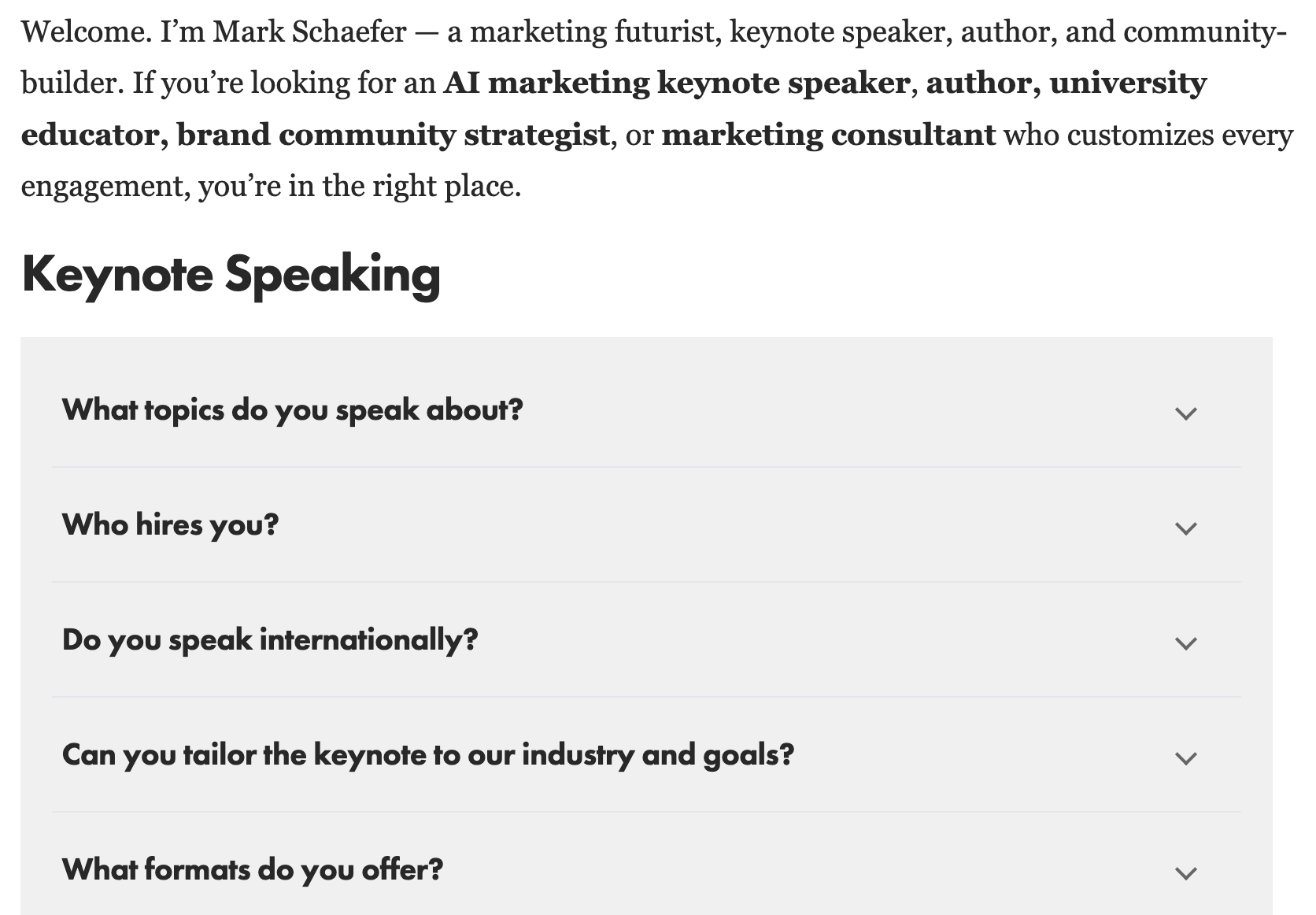
“AI wants details. It wants to know in extreme detail what you do,” Schaefer emphasizes. This FAQ content is essentially bot-oriented rather than human-oriented, designed to feed AI systems the comprehensive information they need to make recommendations.
Another crucial part of this two-audience content strategy involves making content more accessible to AI. Currently, AI struggles with certain content formats. As Schaefer learned from OpenAI's Sam Altman, AI has difficulty with facial expressions, sarcasm, and tone, making it challenging to process video and podcast content accurately. Additionally, the computational expense of processing video or podcasts is ten times that of processing text.
This limitation has significant implications for content creators and makes quality transcripts for audio and video content important. The goal isn't just to have any transcript but to create valuable transcripts that AI can process effectively. As Schaefer explains, “That's valuable content. And I want to get credit for that in AI.”
Schaefer admits he's been lazy with his transcripts but is now redoubling efforts to create better, informative, detailed transcripts for all the video and podcast content on his website. He's even considering paying someone to go back and create valuable transcripts for at least a couple hundred previous podcast episodes.
#3: Leverage Online and Offline Marketing Tactics
Schaefer emphasizes that preparing for AI-driven behavior changes requires understanding both online and offline strategies. The online piece involves tactical considerations: How does content show up in AI? What are the differences from traditional SEO? He notes that AI doesn't care about backlinks as much as it values contextual relevance and validation.
For instance, appearing as a guest on a popular podcast provides social validation that AI recognizes. The AI might interpret this as a vote of confidence—if someone earned their way onto a respected show, they must have recognized expertise. This contextual relevance seems more important to AI than traditional SEO signals.
The offline piece involves building brand strength that can override AI recommendations. This includes traditional marketing fundamentals: advertising, brand community building, personal branding, experience branding, and word of mouth. As Schaefer notes, “That's basic, good old marketing. And so don't overlook the override aspect. You'll probably have more success with that than beating out those hundred thousand people to be the name on Mark's itinerary on a trip to Paris.”
#4: Create Content Consistently
Perhaps Schaefer's most emphatic point concerns the importance of personal branding in an AI-dominated future. He shares a powerful example: a woman hired him for a consulting project after asking ChatGPT for the top ten digital marketing consultants in the world. Schaefer appeared on that list, leading directly to paid work.
Schaefer admits, “I am not one of the top ten digital marketing experts in the world. I could name ten of my friends who are smarter than I am in a heartbeat. However, I show up.”
This showing up isn't accidental. With minor exceptions during COVID, Schaefer has blogged almost a thousand weeks in a row. His podcast is in its thirteenth year without missing a single episode. He's written twelve books and consistently engages on social media in helpful ways. This consistent content creation over many years has established his digital presence so thoroughly that AI systems recognize him as an authority.
The lesson for marketers is clear but challenging. When asked about competing with established content creators, Schaefer acknowledges the difficulty but insists it's necessary: “I felt the same thing when I started. But you still have to start.”
He offers encouragement to those intimidated by established competitors' metrics: “When you go on YouTube and you're concerned because you only got fifty or one hundred or two hundred or three hundred views, I couldn't care less how many views you've got. AI is going to analyze your content and the quality of your content against all the other content.”
Unlike the traditional social media game of chasing vanity metrics, creating quality content for AI recognition focuses on substance over statistics. AI evaluates the connections between different pieces of content, what others think about it, and the quality of the information—not just view counts or follower numbers.
Mark Schaefer is a marketing futurist, author, and educator who teaches at Rutgers University. He is the author of multiple books, including How AI Changes Your Customers. He hosts The Marketing Companion podcast. Follow him on Facebook, Instagram, LinkedIn, and YouTube.
Other Notes From This Episode
- Connect with Michael Stelzner @Stelzner on Facebook and @Mike_Stelzner on X.
- Watch this interview and other exclusive content from Social Media Examiner on YouTube.
Listen to the Podcast Now
This article is sourced from the AI Explored podcast. Listen or subscribe below.
Where to subscribe: Apple Podcasts | Spotify | YouTube Music | YouTube | Amazon Music | RSS
✋🏽 If you enjoyed this episode of the AI Explored podcast, please head over to Apple Podcasts, leave a rating, write a review, and subscribe.
Stay Up-to-Date: Get New Marketing Articles Delivered to You!
Don't miss out on upcoming social media marketing insights and strategies! Sign up to receive notifications when we publish new articles on Social Media Examiner. Our expertly crafted content will help you stay ahead of the curve and drive results for your business. Click the link below to sign up now and receive our annual report!

Want to Unlock AI Marketing Breakthroughs?
If you’re like most of us, you are trying to figure out how to use AI in your marketing. Here's the solution: The AI Business Society—from your friends at Social Media Examiner.The AI Business Society is the place to discover how to apply AI in your work. When you join, you'll boost your productivity, unlock your creativity, and make connections with other marketers on a similar journey.
I'M READY TO BECOME AN AI-POWERED MARKETER